
Living Languages
The blog for the Institute of Modern Languages Research
Constructing the Other: Polish and Russian perceptions of Germany between media influence and individuality
Maren Rohe talks about her research work at the IMLR, as a Sylvia Naish Visiting Scholar
I joined the IMLR as a Sylvia Naish Visiting Scholar from September to December 2018. During this period, I developed the final draft of my PhD thesis entitled “Constructing the Other: Polish and Russian perceptions of Germany between media influence and individuality.” Thanks to the generous support of the IMLR, I was able to focus on my PhD work during this period, and submitted the thesis for examination in February 2019. In particular, in the months of my scholarship, I drafted the comparative chapter as well as the introduction and conclusion of my thesis, and revised my literature review and theoretical framework.
The comparative chapter of my thesis compares perceptions of Germany in Poland and Russia, in particular pointing to differences regarding the way alternative narratives are dealt with by individuals. While in both Poland and Russia, alternative narratives on Germany are present in news media, individuals in Poland are much more likely to pick up these alternative narratives and engage in controversial discussions. By contrast, Russian study participants tended to ignore such alternative narratives and instead follow the narratives presented in state-controlled media much more closely. The chapter analyses potential factors contributing to these differences, such as the political and media system, education system, and real and perceived divisions in the society. It furthermore discusses the significance of Germany as an Other for Poland and Russia as a potential cause for such different ways of discussing Germany: Germany plays a much more significant role and is perceived as much more dominant in Poland than in Russia. Therefore, narratives on Germany are more relevant for the definition of Polish national identity, and there is a clear division between Poles who favour stronger engagement with Germany and those who favour a more cautious approach. By contrast, in Russia, other Others such as the US and the West are more relevant, and Germany is relevant for national identity discourses mainly in so far as it is perceived as more or less associated with the US and the West.
Beyond developing these arguments as well as the other sections mentioned above, my scholarship at the IMLR also gave me the opportunity to connect with the IMLR Graduate Forum, where I presented my research in March 2019.
Maren Rohe, Sylvia Naish Visiting Scholar, Sept-Dec 2018
‘Damals, dann und danach’: Barbara Honigmann at 70
Former IMLR student Margaret May writes about the symposium held at the IMLR on 25 February 2019.
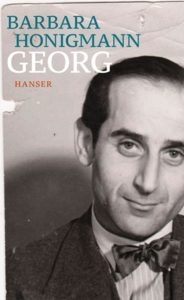
On 25 February the Institute of Modern Languages Research hosted a unique event: a symposium held in honour of writer Barbara Honigmann’s 70th birthday, in conjunction with an evening meeting between the author and her translator, Judith Köhler, in the now well-established ‘Encounters’ series, which also celebrated the publication last month of Honigmann’s latest book, Georg.
The co-organisers, Godela Weiss-Sussex (IMLR) and Robert Gillett (Queen Mary University of London), both presented aspects of their own Honigmann research and brought together ten other speakers from across Europe and the United States, whose contributions spanned an impressive range of approaches to Honigmann’s work. Several of these focused on her style and detailed aspects of her texts; others situated her work more broadly in the body of ‘German-Jewish’ literature or diasporic writing, given her position as a Jewish writer from the former GDR living in France and writing in German.
This was not the first time the IMLR had welcomed the author: two years ago she had come to read from her recent book Chronik meiner Straße (published in 2015), engaging in a wide-ranging conversation with Robert Gillett which triggered my own decision to explore her work further in my research.
The day got off to a lively start with an exciting account of Honigmann’s neglected first work, the play Das singende, springende Löweneckerchen (1977), by Martin Brady (King’s College London), which he supplemented with contemporary materials including an illegally distributed copy of the original text. It was fascinating to learn not only about the political undertones of this adaptation of a Grimms’ fairy tale with its strong, resourceful heroine, but also how much at odds Honigmann’s own accounts of the state of dramaturgy in the GDR actually were with the reality of her success with this play. This was a theme that ran through the day in explorations of the autofiction/autobiography dichotomy in her work.
Reinhard Zachau (Sewanee,Tennessee) discussed Honigmann’s ‘German-Jewish project’, comparing her experience of reconnection to her Jewish roots, as recounted in three of her autofictional texts, with W. G. Sebald’s approach in Austerlitz (2001), in which the German narrator interacts with the eponymous protagonist, who was rescued from Prague on a Kindertransport but only uncovers his suppressed memories as an adult. In both cases it becomes clear that fictionalisation of family history is one way of reworking traumas for the post-Holocaust generations.
Withold Bonner (Tampere University, Finland) examined post-memory through its relationship with photographs. Although Honigmann, unlike Sebald, does not use photographs themselves in her texts, her ambivalent descriptions of family portraits, which offer only fragmentary glimpses into past loss and destruction, often concealing more than they reveal, play a significant role in a number of her works. This offers a fruitful line of enquiry into the question of the reliability of memory – and indeed the purpose of autofiction.
The religious aspect of the ‘Jewish project’ was explored by independent scholar Malte Osterloh, who focused on its role in providing release from the burden of the past, emphasising that Honigmann did not see Judaism as the ‘right’ answer, but was constantly and consciously undermining her own hopes and expectations of redemption, except through memory and the work of studying and writing about her parents’ past.
By contrast, Rapha Hoffmann (University of Leipzig) focused more on the political aspect of this topic, relating Honigmann’s decision to leave the GDR – despite her need for connection to the German language – to the increasingly marginalised and ultimately untenable position of Jews in the socialist state, using examples from Roman von einem Kinde (1986) to illustrate his argument and making interesting links to other GDR authors.
Lauren Hansen (New College of Florida) situated Honigmann’s Eine Liebe aus Nichts (1993) within the fields of intergenerational memory, family narratives and migration literature, highlighting the theme of spatial migration not just in terms of content but as a formal, structural textual strategy. Lauren referred specifically to the arresting concept (also noted by others) of the shared, overwritten diary, seeing Honigmann’s (or her narrator’s) adoption of her father’s wartime diary (which he himself had re-used a few years later) as an attempt to reintegrate their estranged lives through the physically combined record of their experiences.
Robert Gillett explored Honigmann’s use of letters as a literary device that both suggests physical distance and represents a powerful channel for personal exchange or confessional, exculpatory writing. Speculating on the identity of ‘Josef’ in Roman von einem Kinde, with its possibly Biblical or Kafkaesque associations, he also drew attention to the relationship the epistolary form creates between author, reader and text, both heightening the sense of authenticity in the narration but also, paradoxically, questioning its implied veracity.
Godela Weiss-Sussex discussed space, time and language in a work that has often been critically dismissed, Das überirdische Licht: Rückkehr nach New York (2008), Honigmann’s episodic account of her ‘Randposition’ of distance and belonging during her period as a writer-in-residence in that city in 2005. The author/narrator’s role as an observer and student-like status, with the associated concepts of freedom, flux and mingling of past and present time, created a sense of disorientation but also provided a unique opportunity for unexpected, revealing encounters, openness to new experiences and further reflection on exile identity, as well as raising questions about multilingualism.
In the final panel, Honigmann’s engaging account of her life in Strasbourg, Chronik meiner Straße (2015), was the subject of no fewer than three contributions, albeit from very different perspectives on exile existence. Katja Garloff (Reed College, Portland, Oregon) discussed ‘diasporic place-making’, highlighting how ‘routes become roots’, how Honigmann’s imaginative narrative strategies about arrival, leaving and remaining turn spaces of transition into places of dwelling, and place-making into a form of place-claiming, by investing them with emotional significance and personal meaning.
Derek Wiebke (University of Washington-Seattle) also pursued the theme of (dis-)location, seeing the text as pushing and even extending the boundaries of ‘minor literature’. He highlighted instances of German as a vehicular language for the multicultural community living in the Rue Edel, and the numerous encounters between the personal, political, social and collective observed, experienced and described by Honigmann as a long-term resident in this street.
Among several other presentations that considered linguistic aspects of Honigmann’s texts, the approach to Chronik meiner Strasse taken by Tarek Mahmoudi (Freie Universität Berlin) mirrored my own detailed examination of the nuts and bolts of Honigmann’s carefully crafted texts, including her noteworthy use of modal particles like ‘ja’ to draw the reader in and normalise her experiences, and the particular rhythms of her sentences. Tarek also focused on recurring motifs such as the portrayal of different languages and nationalities, and specific locations of ‘in-betweenness’, in which visits to Jewish cemeteries provide a sense of historical connection that is not necessarily available elsewhere.
My own presentation analysed a chapter from this book and episodes from two earlier works, Roman von einem Kinde and the work aptly chosen as the title of this day, Damals, dann und danach (1999), in order to highlight particular linguistic features of Honigmann’s style and explore how its evolution over thirty years reflected her own journey of self-discovery.
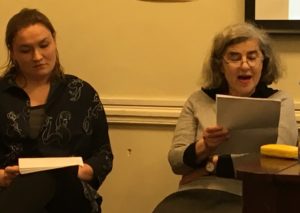
Our enjoyment of the day was immensely heightened by Barbara Honigmann’s presence in the evening, when she read from and discussed her new book about her father, Georg, with translator Judith Köhler, in a public event sponsored by the Keith Spalding Trust. Her work seems to me to invite us to read it aloud, and it was particularly satisfying to hear this in the author’s own voice. Despite the apparent simplicity of the text, Judith had identified numerous pitfalls for the translator, which were the subject of a lively exchange with the audience as well; for instance, how much historical and German literary or local knowledge can one assume from the intended readership, and, in an English translation, how does one, right from the outset, convey all the nuances implicit in Georg Honigmann’s own use of English? In other words, how important is the translator as a cultural communicator? This conversation allowed us to pick up on our earlier discussion of particular, possibly untranslatable, linguistic features of Honigmann’s style.
Throughout this enriching day echoes of other authors – whether stylistically or thematically – were constantly noted, ranging from Kleist to Kafka, Georges Perec to Mascha Kaléko, or Hans (Chaim) Noll to Olga Grjasnowa. One thing emerged clearly from our discussions: academic interest in Barbara Honigmann’s work continues unabated across continental borders. No doubt her latest book will soon also be dissected according to our various fields of interest, but that is because her writing remains so relevant to questions of identity, belonging, migration and much more. Many thanks to Godela and Robert for convening such a rewarding celebratory event.
Margaret May
Dynamic Maghribi Jewish-Muslim Interaction across the Performing Arts
Rebekah Vince (Warwick) and Sami Everett (Cambridge) report on the conference Dynamic Maghribi Jewish-Muslim Interaction across the Performing Arts, held at the Centre for Research in the Arts, Humanities and Social Sciences, University of Cambridge on 5-7 December 2018.
This conference brought together a research network of early career and more senior scholars researching and producing artistic representations across the genres of music, theatre, film, comedy, and art, to discuss how these relate to Maghribi Jewish-Muslim interaction, collaboration, and dialogue from 1920 to the present day. Emphasis was placed on artistic cooperation, intergenerational transmission, creative representation and dynamic interaction between Jews and Muslims on both sides of the Mediterranean. By discussing these themes, the conference challenged polarised narratives surrounding Jewish-Muslim relations in the Maghrib and France which tend to focus either on anti-Semitism and Islamophobia or on nostalgia and utopianism.
Through this bilingual and interdisciplinary conference, we established a network of scholars from France, Morocco, the UK, the US and Canada, including participants from the social sciences, history, literature, anthropology, music, and modern languages. The presentations and ensuing discussions interrogated moments of rupture as well as continuity in Maghribi Jewish-Muslim interaction, the significance of subterranean cultural work of mediation and transmission surrounding memories of Jewish life in the Maghrib, and the potential of performative artwork to challenge stereotypes and offer dialogic alternatives to polarised approaches.
Threads included:
• Multilingualism (localised variants of Arabics in Maghrib/Mashriq and Judeo-Arabic, question of accent, French, Hebrew, Yiddish), translation
• The role of humour in depicting Muslim-Jewish interactions and satire as catharsis
• Absence/presence of Jews in the Maghrib as manifested in performance art
• Influence, aesthetics, and performance relating to Jewish-Muslim interactions
• Memory and amnesia of Jewish life in the Maghrib as depicted in (or left out of) performative artwork
• Challenging stereotypes and assumptions through performative collaboration
Questions that emerged included:
• How to look at the specificities of cultural interactions within temporal and geographical context
• How to talk about the Maghrib in relation to Israel/Palestine without diminishing the importance of local interactions historically and in the present day
Conference Overview
Keynote 1: Valérie Zenatti (independent author), ‘La mémoire trouée [Perforated Memory]’
The conference began with an autobiographical keynote in French by Valérie Zenatti, author, screenwriter, and translator of the late Aharon Appelfeld (from Hebrew into French). Born to Algerian and Tunisian Jewish parents, Valérie Zenatti grew up in France where her encounter with the Holocaust was mediated through the American television series Holocaust (1975) and later through the writings of Ukrainian-Israeli writer Aharon Appelfeld, whose translator she was to become. Her affiliative relationship with Aharon Appelfeld is recounted in her (auto)biographical novella Mensonges [Lies] (2011) which preceded her prize-winning novel Jacob, Jacob (2015), an exploration of Jewish life in Algeria during the Second World War and decolonisation. Both these texts, alongside Une bouteille à la mer de Gaza [A Bottle in the Gaza Sea] (2005) and its film adaptation, featured in her conversational keynote, which addressed issues of memory and forgetting, filiation and affiliation, erasure and reconstitution. Questions and ensuing discussion revolved around the (im)possibility of return, the absence of Muslims in some accounts of Jewish life in the Maghrib, and dialogic approaches to the Israeli-Palestinian conflict. Watch the trailer to Une bouteille à la mer de Gaza [A Bottle in the Gaza Sea] (2005).


Session 1: Popular Music
Chaired by Ruth Davis, University of Cambridge, this session explored Jewish-Muslim dynamic interaction in Maghribi popular music, from concert halls in the interwar Maghrib (Chris Silver, McGill University) to narratives of peaceful religious coexistence in Moroccan patriotic rap (Cristina Moreno Almeida, King’s College London). Listen to Casa Mdinti – V-mic featuring Bizz-tourisque (2006).
These presentations prompted discussion around the construction of the nation and engaging in politics with a capital or lower-case “p”.


Session 2: Staging and Performance
Chaired by Arthur Asseraf, University of Cambridge, this session included a presentation by Mourad Yelles, INALCO, on theatre as meeting point between Algerian Jews and Muslims with a particular focus on the Jewish actress Marie Soussan. Listen to Marcha Djazairia.
This led to a discussion on similar values among Jewish and Muslim families, and a shift in focus from a socio-cultural analysis to a political and aesthetic one. The session also included a presentation by Adi Bharat, University of Manchester, on how the conflictual model of Jewish-Muslim relations in France is challenged through stand-up comedy, taking the comedy duo Younes and Bambi (‘l’Arabe et le Juif’ [the Arab and the Jew]). This raised questions about exaggeration to the point of ridicule and reinforced the general consensus at the conference that interactions is a more useful concept than relations when speaking about Jewish-Muslim performance art in terms of influence and collaboration.


Session 3: Cinematic Representation
Chaired by Rebekah Vince, University of Warwick, the discussion in this session revolved around cinematic, musical, and linguistic depictions of Jewish-Muslim relations in both Morocco and Israel. Presentations were given by Miléna Kartowski-Aïach, Idemec/Université d’Aix Marseille, on forbidden memory and political song in Kamal Hachkar’s mediatory films, and by Chana Morgenstern, University of Cambridge, on decolonising Hebrew through Arabic in the film adaptation of Almog Behar’s prize-winning short story “I’m one of the Jews”. This led to a debate on whether or not Palestine/Israel can ever be excluded when speaking about Maghribi Jews in the contemporary moment, even in analysing Jewish-Muslim interactions in North Africa before the foundation of the State of Israel.


Keynote 2: Jonathan Glasser, Associate Professor of Anthropology, William & Mary, ‘Maghrebi-Jewish Musical Intimacy’
This keynote began with an analysis of how music seems to challenge discourses of antagonism that emphasise Muslim-Jewish conflict and posit Jews as pariahs in North African society. Yet a closer look revealed that Muslim-Jewish interactions music and surrounding debates were nevertheless marked by tropes of rivalry, marginality, and ambivalence. Jonathan Glasser focused on the case of Algeria to account for the centripetal forces of these tropes and to provide a rich alternative for understanding Muslim-Jewish dynamic interactions in the Maghrib and its diaspora.
Session 4: Comedy and Satire
Chaired by Warda Hadjab, EHESS, this session looked at absent depictions of Jewish heritage and Muslim-Jewish relations in Algerian caricatures and graphic novels from 1967 through the 1980s (Elizabeth Perego, Shepherd University), and creative co-existence in the work of street artist “Combo” (Nadia Kiwan, University of Aberdeen). These presentations were a springboard into discussion about whether we are dealing with total rupture or lingering traces when addressing the immediate post-independence period: Chris Silver suggested we might talk about ruptured continuity. We also addressed the question of gender (“Is street art male?”) and the extent to which displaying religious symbols in public space acts as a provocation in secular France. Continuing with concepts of satire and comedy, we considered how malaise is dealt with via the medium of humour, how assumptions are deconstructions, and how anti-Semitism and Islamophobia are challenged through performative artwork.


In the concluding comments, the question was again raised, this time by Arthur Asseraf, University of Cambridge, as to the breakdown, rupture, and absence of the immediate post-independence moment. Often when looking for interactions, our attention is drawn to the interwar period or more recent examples. Chris Silver suggested that there was a possibly nostalgic need to fill the absence. The Christian question was also raised: Christians are often depicted as the dominant power yet, in the Arab world at least, Christians have a distinctive (minority) identity. Seth Anziska, UCL, noticed how the conference was working against the lachrymose view of history and this led to a discussion on whether or not we were engaging in “grieving cosmopolitanism” and the potential (creative or otherwise) of this concept, which need not be a negative one. Jonathan Glasser suggested that co-resistance was a useful way of looking at performative collaboration and co-creative artwork. Vanessa Paloma Elbaz, University of Cambridge, brought up the myth of “the last Jew” and the phenomenon of contemporary Muslims self-identifying with a suppressed past, notably in relation to Judeo-Berber identity within the Arabo-Muslim context of the Maghrib. Miléna Kartowski-Aïach spoke of the subterranean work and the role of mediators in the transmission of cultural memory, which is beginning to bear fruit in changing perceptions and opening a space for interfaith dialogue.
Co-conveners: Dr Sami Everett (University of Cambridge), Dr Arthur Asseraf (University of Cambridge), Dr Rebekah Vince (University of Warwick)
Sami Everett, University of Cambridge, and Rebekah Vince, University of Warwick, are co-editing a volume on Dynamic Maghribi Jewish-Muslim Interaction across the Performing Arts commissioned by Liverpool University Press for publication in their Francophone Postcolonial Studies series in 2020.
Supported by the Centre for Research in the Arts, Social Sciences and Humanities (CRASSH), the European Association for Jewish Studies (EAJS), the Institute of Modern Languages Research, Université PSL, and the University of Cambridge’s Faculty of History.
.
Common Scents: Smells and Social Life in European Literature (1880-1939)
Sasha Rasmussen discusses the recent conference ‘Common Scents’ held in November 2018 at the IMLR:
In late November, the Institute for Modern Languages Research hosted ‘Common Scents’, a two-day conference with an interest in all things olfactory, framed by the literature of the late nineteenth and early twentieth centuries. Across the varied and thought-provoking papers, the speakers engaged with scent through a range of lenses, including disgust, dissimulation, exoticism, pleasure, sexuality, and consumerism.
 Perhaps the most fundamental theme of the conference was the epistemological role of smell, and the kinds of knowledge it can provide. The opening keynote paper by philosopher Barry Smith laid the foundations for many of the ensuing discussions, by setting out the basics and recent discoveries of the neuro-physiological science of smell. He stressed the strong and immediate link between the sense of smell and the emotions, a topic we were to return to repeatedly over the course of the conference. Erika Wicky tackled this question directly in her paper ‘The Dandy’s Nose: Aesthetics and Olfactory Sensitivity in French Literature of the fin de siècle’, teasing out the importance of smell in art connoisseurship. She argued that as the viewer approaches the canvas, they move from the visual to the olfactory, and from the objective to the emotional or experiential.
Scent also served as an important marker in other contexts: bad odours were variously identified as a sign of the lower classes, of poor moral conduct, and sexual decadence or degeneracy. This is testament to the understanding of smell as ‘the truest sense’. However, as we heard, the nose can also be fooled: sweet perfumes were thought to mask reality, allowing women to present themselves not as they are, but as they wish to be read by passing strangers.
Scent has, as Catherine Maxwell put it, ‘an unrivalled ability of evoking past states of feeling’. But this ability was also commodified and subverted. As Jonathan Day argued (in absentia), there came a point when the answer to Molly Bloom’s question, ‘what perfume does your wife wear?’, was answered with a brand name, not a material substance like violet or lily of the valley. The narratives carried by various scents, too, were commercialised, as Tag Groenberg outlined in her paper on the marketing of abstract perfumes, ‘Shalimar and Vol de Nuit (Guerlain): Scents of Presence and Loss’. Expectations regarding gender were a powerful force in shaping such narratives, as Maria Weilandt and Sophie-Valentine Borloz both demonstrated in their analyses of French literary examples from the fin-de-siècle.
Many presentations across the two days dealt indirectly with the difficulties of conveying the so-called lower senses – and smell in particular – to a reading audience through language alone. Perhaps to partially counteract such difficulties, several sessions featured olfactory props: Catherine Maxwell passed around samples of damask rose, narcissus, and a sprig of myrtle during her keynote on scent in the works of Vernon Lee. Isabelle Chazot of the Osmothèque in Paris brought with her a recreation of a 1905 perfume by Koty from the organisation’s curated collection of perfumes, past and present, allowing attendees to catch a whiff of the belle époque. Experiencing the scent ourselves added a new dimension to the conference, although for me as a historian this raised questions about the contingent nature of sensory experience and the immeasurable distance between our own interpretive framework and that of the past.
The conference also took a strong interest in the ‘synaesthetic moment in modernist literature’, and particularly the relationship between smell and sound. Zola offers a number of evocative examples, from the ‘cheese symphony’ of Le Ventre de Paris to Albine in La Faute de l’Abbé Mouret, who as she died ‘listened to the perfumes’ of the flowers which filled her bedroom. In complement to these French examples, Frank Krause gave a detailed consideration of this phenomenon from a Germanic perspective in his paper ‘Innovative Smell-Sound Synaesthesiae: Diagnoses of Social Life in German Literature’. The ways in which the senses might be unexpectedly juxtaposed, so that smell might comment on sound and vice versa, holds exciting potential for future research.
Overall, the conference represented a fascinating cross-section of current scholarship concerned with scent and its representations. An enormous thank you and congratulations are owed to the organisers of the conference – Katharina Herold, Frank Krause, and Godela Weiss-Sussex – for their efforts in bringing together such a stimulating event.
Sasha Rasmussen, PhD student, (St Hilda’s College, Oxford)
.
Still Caught in the Cross-Fire: Translating British Women’s Pro-Franco Memoirs of the Spanish Civil War
Jonathan P.A. Sell (Alcalá) talks about his experience of translating pro-Franco memoirs of the Spanish Civil war
As children we have all felt the allure of the liverish reds or pumpkin oranges of river-bed and rock-pool pebbles. We have all, too, been disappointed once, removed from their liquid habitats and arranged on a windowsill to dry, those pebbles lose their sheen to become nondescript stones that gather dust before being chucked out into the garden. Change pebble for source text and rock pool or riverbed for source culture and you have a metaphor for what the less optimistic believe happens when translating a piece of literature from one language to another (1). The source culture is the environment in which the literary text is constituted and which is, in its turn and in the reciprocal manner of natural relations, reconstituted—albeit minimally, imperceptibly—by it. Outside the culture and the linguistic community which are its natural habitat, translated from one language to another, the literary text is left to flounder like a fish out of water until, starved of the oxygen that once sustained it, the scales turn lacklustre, the fins cease to flap, and, having reached the end of its shelf-life, it is de-catalogued and sent for pulping. What distinguishes literary texts from others, we are led to believe, is their quotient of art, their beauty; and it is their art or beauty that gets lost on translation. As Gilles Ménage put it in the eighteenth century, if the target text is faithful on the semantic level, it will be aesthetically ugly; if beautiful as a piece of art, it will be unfaithful in terms of meaning—Ménage’s belle infidèle (2). In Robert Frost’s terms, “poetry […] is that which is lost out of both prose and verse in translation” (3).
The more optimistic think otherwise. While aware that translation is a matter of losses and gains, they consider that, on the whole, “a live dog is better than a dead lion” (Ecclesiastes 9:4), a dull stone on the windowsill is preferable to no stone at all. Casting their eye over the ranks of landmark translations, they admit that, of course, the King James Bible, Arthur Golding’s Metamorphoses, Thomas Shelton’s Don Quixote or Edward Fitzgerald’s Rubaiyat of Omar Khayyam are no substitute for the real thing, but they are a great deal better than nothing. For the optimists believe that a pebble can be transferred from one riverbed to another, where, although the quality of the light and the chemical constitutents of the water will alter the sheen and the hue, the pebble may still glimmer, its colour may still entice and, in its own small way, the course of the new river will be ever so slightly altered. Translation is adaptation, they say, intoning piously the hoary old adage, but it is also co-adaptation: the text will be modified on assimilation into the target culture, but that culture will be modified too.
It was the optimistic view that I used to take when teaching my students of literary translation. However, recent experience of the reception of two translations of my own suggests that the strength of target culture currents may simply sweep foreign elements away. As member of a Spanish government-funded research project, the goal of which was to make available to Spanish readers forgotten texts written in English by witnesses of the Spanish Civil War (1936-39), it was my job to produce editions and translations of two books, Eleonora Tennant’s Spanish Journey (1936) and Florence Farmborough’s The Life and People of National Spain (1938). The first point to be made here is that neither work can press any serious claim to literary status; indeed, when translating both, I often found the temptation to improve the originals hard to resist. That said, both editions were attractively produced and marketed for educated readers of literary memoirs and/or Civil War history.
Both Tennant and Farmborough made Franco’s cause their own; indeed, Farmborough, nursing heroine of the First World War, was the English-language broadcaster on Franco’s National Radio. Both were ferociously anti-communist and believed quite sincerely that Franco, Mussolini and Hitler would act as a bulwark against Russia in defence of a way of life and, in the case of the family Tennant married into, a business empire they held dear. Both were ideologically antipathetic to their translator (I had picked the two shortest straws when at the project’s planning stage the various texts to be translated were shared out) and it would have been easy for me to research and write respective historical and biographical introductions which peddled preconceived ideas and conformed to comfortable stereotypes. However, I felt it was my job to make an impartial contribution to the historical record and to give my authors a fair hearing. What counted was their testimony, what mattered that my translations should convey that testimony as accurately and accessibly as possible and that my introductions and notes should furnish Spanish readers with all the information necessary for them to see the texts in their contexts and draw their own conclusions.
In fact, as I discovered while working on both authors, what was most interesting about their largely propagandising testimonies was not the content or the opinions voiced, but the voices themselves, the voices of two extraordinarily independent women with very human concerns and hearts in the right place. The lesson I myself had extracted from editing and translating their texts was that for all the extremity of their political positions or the unfortunate directions their anxieties led them to pursue, both Tennant and Farmborough had a right to be heard and, above all, to be understood. In this sense, both their works translated into Spanish would, I fondly hoped, ever so slightly alter the course of the current of received opinion about the Spanish Civil War.
Unfortunately, my hopes were misplaced. That current is heavily politicised, its course contested by the grandchildren of the Nationalists and Republicans who fought it out in Spain’s tragically fratricidal conflict. The losers of the war have become the victors of the peace and it is hard to question the prevailing “history” of the sad events that divided families, villages, cities and nation. That history is the politically correct one, the “progressivist” one, the one democrats in general and, in particular, the parties of the left and the centre (which includes the moderate left and the soft right) are duty-bound to conserve intact. Thus, researchers who dig up data from the archives corroborating stories of the “Red Terror” find themselves branded as fascists and blackballed in academic circles. Thus, my attempts as translator to add to the historical record two new voices by mediating between Tennant and Farmborough and their historical and vital contexts on the one hand and, on the other, twenty-first century Spanish readers and theirs, have come to a sorry end.
Given the prevailing “history”, the publication of Civil War testimony written by Republican sympathisers is a prospering cottage industry. Less usual is the publication of similar material by pro-Nationalists. The fact that my authors were not only pro-Nationalist but also women meant that they attracted a certain amount of media interest. I was invited to take part in a radio-chat on Spain’s leading private channel, Cadena Ser, part of the pro-Socialist Party media giant, Prisa. Intent on emphasising the deep human and historical interest of the translated works, I feared the worst when I saw the programme’s blog trail the chat under the title “Franco’s groupies” (“Las grupis de Franco”). My authors had already been made to fit the stereotypes and, as a corollary, turned into objects of progressivist ridicule; my efforts during the programme to reset the scales met with considerable resistance from the anchorman, who had already written his story. The two books were also featured in a cultural space on Cadena Ser’s rival, Onda Cero. There, the centre-right orientation of the channel could be detected in its title, “Franco’s cheerleaders” (“Las cheerleaders de Franco”), “cheerleaders” being a rather more positive sobriquet than “groupie”. The participants in the programme tended to focus on anecdotal details rather than big pictures and replaced Cadena Ser’s scoffing belittlement with wry amusement. According to which side of the political fence one was on, Tennant and Farmborough had either to be dismissed with scorn as unwelcome guests or excused with the exculpatory smiles of hosts apologising for the presence of eccentric or undesirable members of the family.
As the political atmosphere became increasingly highly-charged in the wake of the unofficial referendum about Catalonian Independence, a columnist in the right-wing daily newspaper ABC noted how the term “fascist” was becoming order of the day for anyone who stood up for the state of law and recommended adopting Farmborough’s “fun” rhetoric as an antidote to the resuscitation of Franco as the favourite bogeyman of the left. A little earlier, as controversy raged over the new socialist government’s plans to disinter Franco’s corpse from the megalomaniac Valley of the Fallen, in his column for the right-wing daily El Mundo, the well-known writer Fernando Sánchez Drago quoted Tennant’s work as evidence of the Red Terror. With the so-called Historical Memory Act (Ley de Memoria Histórica) in their hands, the socialists’ planned profanation of Franco’s tomb was just another in a long line of left-wing anti-clerical outrages typified by the burning of churches and murder of priests and nuns during the Civil War, as attested by Tennant. Sánchez Drago appeared not to have read (or to have forgotten) my introduction’s account of how the testimony of foreign observers was often written for them by press officers at the Nationalist Press and Propaganda Delegation.
So my own attempts to enhance Spain’s historical memory, to ever-so-slightly alter the course of received historical opinion by adding to it the voices of two witnesses to the Civil War, were stymied by the force of a highly-politicised current whose lines are already well-drawn and inflexible. Sadly, those lines reproduce the battle-lines which fissured the Spanish nation during the Civil War and still scar the collective subconscious. And while a new ultra-right-wing party emerges onto the hustings and into the regional parliament of Andalusia, as a translator I register the irony that under the name of “Vox” (= voice), that party’s natural constituency is unwilling to give a fair hearing even to those voices who represented its cause eighty years ago. As translator, too, I register the tragedy that those who claim to stand for the values of progress, democracy and civil liberties are similarly deaf to voices that form part of the very historical memory they allegedly defend.
In short, it will take more than a couple of pebbles to change the course of Spain’s history. The force of received opinion is so strong, the banks so heavily reinforced by the concrete of ideological inflexibility, that Tennant and Farmborough will soon be carried away to the sea of oblivion. And could they take a peek as they rush downstream, they would easily recognise the river’s route, flowing as it does between the same lines they reported in their testimonies which, now translated, few are disposed to heed.
Jonathan P.A. Sell, University of Alcalá, Spain
(1) The metaphor is from Eamon Grennan’s introduction to Giacomo Leopardi’s Selected Poems (Princeton: Princeton University Press, 1997), pp. XVIII-XIX. See Franco Nasi, Traduzione estremi (Macerata: Quodlibet, 2015), pp. 143-4.
(2) Ménage is quoted in Amparo Hurtado Albir, La notion de fidélité en traduction (Paris, Didier Érudition, 1990), p. 231.
(3) Robert Frost, Conversations on the Craft of Poetry (New York: Holt, Rhinehart and Winston, 1961), p. 7.
.