
Living Languages
The blog for the Institute of Modern Languages Research
An academic match made in heaven
Katia Pizzi, Senior Lecturer (Italian Studies) at the IMLR, talks about her recent week spent at the University of Coimbra.
 Thank you EU! I spent a most enjoyable and productive week at the University of Coimbra in Portugal in late November, thanks to a recently established Erasmus staff mobility agreement with the School of Advanced Study, University of London. The invitation came from Coimbra University’s Centre for Social Studies (CES), a hub of transdisciplinary research and advanced training in the Social Sciences and the Humanities, a sister institution of ours.
CES’s main aims are democratising knowledge and revitalising human rights in response to societal needs. Particular focus is on North-South and South-North dialogues: the library of CES bears the same name and is managed with energy and good humour by the formidable Maria-Jose Carvalho. In this frame I had fruitful meetings with students, researchers, colleagues and teachers. My seminar for the ‘Translocal Modernist Magazines and Cultural Networks’, attended by the students and academic staff of CES, addressed issues of peripherality in modernity.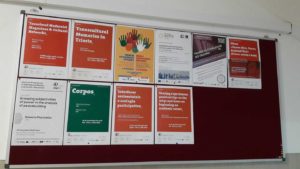
In the lecture ‘Transcultural Memories in Trieste‘ I discussed transcultural memories in border areas in the context of globalisation, a topic of CES’s particular interest. In a further seminar I was lucky enough to interact with a large class of students and postdocs whose research in the Lusophone context maps onto the research of the Centre for the Study of Cultural Memory at the Institute of Modern Languages Research. In a summer school planned for autumn 2019, Creative Writing will be used as a method of enquiry to explore these issues.
Thank you Maria-Irene, Patricia, Antonio, Bruno, Maria-Jose, Ines, Acacio, Nancy and Gabriele for your generous and warm hospitality! I very much look forward to welcoming you in London and to pursuing further collaborations.
Dr Katia Pizzi, Senior Lecturer (Italian Studies), IMLR
.
Portraitomania and Intermediality in Nineteenth-Century France
Dr Kathrin Yacavone reports on the study day La Portraitomanie: Intermediality and the Portrait in 19th-Century France held at the IMLR, Senate House, London in September 2018.
On Friday 14 September 2018 the Institute of Modern Languages Research hosted an interdisciplinary stay day that brought together scholars from Belgium, France, the UK and the USA who are currently collaborating on a special journal issue of L’Esprit créateur on La Portraitomanie: Intermediality and the Portrait in 19th-Century France, guest-edited by Érika Wicky and Kathrin Yacavone (forthcoming in March 2019).
Scholars have hitherto tended to analyse the portrait through the lens of a specific medium (such as painting, photography or literature), a particular individual, or a group of writers and artists for example. The aim of the study day, by contrast, was to examine the nineteenth-century portrait in France with an emphasis on transmediality – that is, how the portrait genre travelled from one medium to another – as well as intermediality, whereby portraits originating in different media were brought together in the same works. This context was outlined in the opening remarks by Dr Érika Wicky and Dr Kathrin Yacavone who focused on the portrait/‘portraitomanie’ and intermediality, respectively.

Nadar, Self-portrait, 1864 (BNF, Paris)
The following six papers and response papers examined the highly malleable definitions and manifestations of the ‘portrait’ – in written and visual forms – in nineteenth-century France. Professor Adeline Wrona presented on caricatures and photographs of the journalist Émile de Girardin, while Professor Elizabeth Emery focused on the journalistic ‘portrait’ as a genre mastered by Adolphe Brisson and developed out of the interview and the literary portrait. The representation in popular print media of the famous maître d’hôtel François Vatel was the topic of Professor Michael Garval’s paper and Dr Edward Nye looked at portraiture in the context of theatre, that is, the portraits of the Pierrot actor Jean-Gaspard Deburau reproduced in Jules Janin’s Deburau, ou L’Histoire du théâtre à quatre sous. The author portraits of George Sand by the famous caricaturist and photographer Nadar were the topic of a paper by Dr Kathrin Yacavone and Dr Érika Wicky presented on close-up portraits of painted figures that circulated independently of their original painterly contexts in photographic formats. The discussion of these core papers was enriched by three responses: Dr Frédérique Desbuisson identified the ideas of marketisation and recycling as an integral part of ‘portraitomanie’; Dr Maria Scott highlighted the common themes of vanity, politics and the blurring of the distinction between private and public, as all relevant to portraiture and intermediality; and Professor Richard Wrigley concluded the day’s reflections with thoughts on the limits of the portrait genre from an art historical perspective.
During the day there were many opportunities for discussion and debate and all participants were grateful for the warm welcome at the IMLR. The organiser thanks the IMLR and Jenny Stubbs, in particular, for her support before, during and after the event and also wishes to acknowledge financial support by the Cassal Endowment Fund, the Society for French Studies and the University of Nottingham International Collaboration Fund.
Dr Kathrin Yacavone is Assistant Professor in French at the University of Nottingham and, from February 2019, Humboldt Research Fellow at the Universities of Constance and Cologne (Germany). Her research focuses on author portraits and the construction of literary authorship in France from the nineteenth to the twentieth centuries (see www.portraitofthewriter.com).
.
Women in Transition – Crossing Borders, Crossing Boundaries
Deirdre Byrnes (NUI Galway/IMLR) reports on Day One (Panels 1, 2 & 3), and Rosa Churcher Clarke (Lisbon) provides an overview, of this three day conference held on 20-22 September 2018
The conference “Women in Transition” attracted a truly multilingual and interdisciplinary group of scholars, sociologists, psychotherapists, clinicians, writers and creative practitioners who came together at King’s College London and St. Peter’s College, Oxford over a three-day period (20-22 September 2018) to discuss the themes of crossing borders and of crossing boundaries. In a world where the desire to restrict entry and even to close geographical borders altogether is growing at an alarming rate, this conference offered a timely intervention by highlighting the creative possibilities and emancipatory potential that the crossing of biological and geopolitical borders and of emotional, sexual, cultural and linguistic boundaries can bring.
The event was planned in association with the Centre for the Study of Contemporary Women’s Writing (CCWW) at the Institute of Modern Languages Research and with the support of TORCH (The Oxford Research Centre in the Humanities); SPLAS (Spanish, Portuguese and Latin American Studies), King’s College London; Instituto Cervantes, Londres; and the Camões Centre, King’s College London.
 The organisers Maria-José Blanco (SPLAS; CCWW) and Clare Williams (Portuguese, University of Oxford; CCWW) extended a warm welcome to all delegates who had travelled to the Strand Campus of King’s College London for the first day of the conference. The opening panel was devoted to the body/mind theme. In her paper “Deep time: Thinking between the corporeal, the mineral and the metallic with Marie-Claire Bancquart”, Emily McLaughlin (Wadham College, Oxford) explored how Bancquart’s poems defamiliarise our perception of bodily events and processes by contrasting everyday images of the human body with microscopic or macroscopic visions. She then widened the scope of her paper in order to consider how the intra-active corporeal processes described in Bancquart’s poetry can offer a productive way of thinking about geophysical and planetary transformation.
Monica Varese’s paper “Beyond ʻChloe liked Oliviaʼ” traced the development in the portrayal of lesbian characters in Kate O’Brien’s oeuvre. There is a veiled epiphany moment regarding lesbian sexual awakening in The Land of Spices (1941), a novel widely acknowledged to contain autobiographical elements. Although the relatively minor character of Agatha Conlon considers herself to be doomed in Mary Lavelle (1936), her sympathetic portrayal in the novel constitutes, Varese argued, the beginning of an acceptance of lesbianism. This development culminates in the protagonist Clare’s full acceptance of – and joy in – her sexuality, as well as her complete rejection of ecclesiastical authority and condemnation, in O’Brien’s last published novel As Music and Splendour (1958).
In her presentation “Creating a liminal space of transition for women with chronic pain”, psychotherapist Elizabeth McCrory (University College Dublin) described the process and the results of a contemplative psychotherapeutic intervention with a group of twelve women, aged between 31 and 69, all of whom were suffering from non-malignant, treatment-resistant chronic pain. The participants undertook ten one-to-one sessions over a 25-week period in a process involving authentic dialogue recordings, journalling and reflective exercises. McCrory’s study, which began life as a PhD, hypothesized that resistant chronic pain compels the sufferer to confront the True Self. Drawing on the spiritual writer Richard Rohr’s description of liminality as being between one’s comfort zone and any new possible answer as well as on the anthropologist Victor Turner’s “betwixt and between” definition, McCrory showed how the creation of a liminal space through contemplative psychotherapeutic intervention enabled the process of pain and suffering to be experienced in a new way, leading to a deeper experience of the True Self.
Day One of the conference featured two panels on motherhood. In “Motherhood beyond the body”, Indrani Karmakar (University of York) examined the portrayal of non-biological motherhood in Anita Desai’s novel Clear Light of Day and in Nandita Bagchi’s short story “Bilkisu Becomes a Mother”. She highlighted the sharp contrast in Desai’s novel between the indifferent biological mother and the loving, but childless Aunt Mira. In Bagchi’s short story, it is a local Nigerian woman Bilkisu who saves the little boy from a poisonous snake in his biological mother’s presence. What demarcates the line between mother and employed care-giver in mother-work?, Karmakar asked, concluding that the uneasy question of sacrificial, altruistic motherhood remains unresolved in both texts.
While Sandra Daroczi (University of Bath) focused primarily on the novel Meurtre à Byzance (2004) in her paper “Crossing the border between theory and practice: Motherhood and maternity in Julia Kristeva’s fiction”, she also made reference to Les Samouraïs (1990), to Thérèse mon amour and to “Stabat Mater”, Kristeva’s 1977 essay which highlighted the need for new discourses of motherhood. Daroczi argued that the character of Christine represented one of the most positive depictions of motherhood in Meurtre à Byzance, foregrounding, in particular, her use of silence as a constitutive element of her enabling motherhood: “Son silence complice […] laissait toute la place à nous autres”.
The first panel of the afternoon also focused on motherhood. In her paper “Cascading transitions and maternal experience”, Anna Johnson described two transitions precipitated by motherhood – becoming a writer and being assessed for Asperger’s Syndrome. She offered a powerful reflection on what she termed the strangeness of her experience of motherhood. Her paper demonstrated the creative potential of such periods of transition – Johnson began writing a year after her son’s birth as a response to a deep-seated need to find an outlet for her creativity. She is about to embark upon a PhD in Creative Writing on the subject of motherhood and performativity.
Continuing in equally candid mode, Anna Maratos and Clare Sandling spoke about their own experiences of motherhood during the presentation “Parenthood as mutative crisis: Balancing the masculine with the feminine when society forces a rift”. (The third contributor, Alex Mankowitz, was unable to attend due to illness.) Framing her analysis within Heidegger’s distinction between calculative and medidative thought, Maratos argued that society needs to value both equally. Clare Sandling spoke movingly about her experience of serious illness after becoming a mother. Drawing on her research as Women in Work policy lead at the UK Government Equalities Office, she noted that the gender pay gap is still at a very dispiriting 18%, before going on to present some images from the “Share the joy” campaign. This campaign, which promotes shared parental leave, is one example of the more merged and blended modes of being that society must allow for both parents, Maratos and Sandling argued, if the rift caused by parenthood is to be overcome.
Deirdre Byrnes (NUI Galway and Visiting Fellow IMLR)
The Women in Transition: Crossing Borders, Crossing Boundaries conference took place across three autumnal days in September (20th-22nd), with some very changeable weather reminding participants of the seasons’ own transition-in-progress. Firstly at King’s College London, and then in St Peter’s College, Oxford, academics, artists and professionals from various different sectors came together from all over the world to discuss and reflect on the immensely broad and varied notion of transition, and, more specifically, how this is and has been experienced by women.
Presentations of twenty-six academic papers were interspersed with: a film screening by Catalan film-maker Mònica Rovira; an interactive performance piece by the Istanbul Queer Art Collective; the inauguration of a temporary exhibition – Representatives – showing work by London-based Brazilian women artists; readings and conversations with Spanish author Marta Sanz and English author Joanna Walsh; and the launch of a collection of short-stories by contemporary Portuguese women writers, translated into English by Margaret Jull Costa.
The transitions explored during these three days of exchange and discussion ranged from the corporeal and psychological – puberty and the menopause, motherhood, confrontations with pain and health diagnoses – to geographical, cultural and linguistic dislocations, as well as sexual, romantic and relational transitions, and also an exploration of the frontiers between various different art-forms and genres. With the conference’s rich and powerful theme serving as a description of not only its academic focus but also many of its participants’ own identities as women in transition (between countries, languages, life-stages, professional quarters, etc), the atmosphere which developed across the course of the three days was one of refreshingly open and engaged dialogue, in which the personal and professional came together to academically and artistically fruitful, thought-provoking and greatly enjoyable effect.
It remains to be seen whether the meeting of frontiers – between different institutions, disciplines and fields of study – which took place during Women in Transition: Crossing Borders, Crossing Boundaries, will prompt further interaction and future collaborations – an extension of the conference’s own temporal and spatial limits such as this deeply creative and constructive event deserves.
Rosa Churcher Clarke (Lisbon)
.
Death and Dying, in the Long Eighteenth Century (and Today)
Dr Ellen Pilsworth reports on the symposium Death and Dying in the Long Eighteenth Century held at IMLR, Senate House, London in September 2018
On 25 September 2018, researchers of eighteenth-century literature and culture gathered from around the world at the Institute of Modern Languages Research in Senate House, London, to discuss how death and dying were conceptualised, represented, and greeted in their period of study. In her opening remarks, organiser Dr Ellen Pilsworth discussed the differences of mindset around death and dying in this period – citing not only the religious frameworks within which it was often (though not always) conceived, but also the far higher mortality rates in this period, particularly for children under five. While death and mourning were seen in the eighteenth-century as a normal part of life, in our own contemporary culture death has now become a ‘taboo subject,’ as Geoffrey Gorer remarked in Death, Grief and Mourning in Contemporary Britain (1965). A study of approaches to death and dying in the eighteenth century can show us, therefore, which ideas and practices we have lost since then, as well as which fears and anxieties have remained with us despite medical and social developments.
 James Metcalf kicked off the first panel exploring approaches to death in eighteenth-century literature with his paper on ‘The Eighteenth-Century Churchyard as a Contemplative Landscape.’ Through a reading of texts produced for and inspired by the graveyard, Metcalf demonstrated the significant cultural importance of graveyards as places for the dead to communicate with the living, and for the living to contemplate the space between being and non-being. Phoebus Cotsapas followed this with his consideration of Diderot’s philosophy of death from a materialist perspective, seeing all life as being made up of matter that lives on beyond our own lifespan, before Joanna Raisbeck built on this by showing Günderrode’s own reflections on mortality within the framework of Spinozism.
After a break for lunch, we divided into two panels. One focused on German literature, with three papers by researchers Dr Dagmar Paulus (on death as atonement in the German Schisalsdrama), Dr Philipp Ritzen (on death and dying in Heine’s Romanzero), and Dr Kristin Eichhorn (on joi de vivre in Gellert’s novel, Leben der schwedischen Gräfin von G***). The other panel featured two papers concerned with the grey area between death and life, both as a medical problem (‘apparent death,’ explored by Dr Simon Aeberhard) and as an effect of highly realistic painting in the work of John Singleton Copley, explored by Caroline Culp.
The final panel explored eighteenth-century institutional approaches to death, within the framework of job applications and funeral sermons (highlighted by Stephan Strunz) and with reference to the Christian teachings on hell and damnation (analysed by Professor Ritchie Robertson).
 After closing remarks from the organiser, participants retired for a quick half pint before joining with members of the public in Moreish Café Deli for an official Death Café, facilitated by Ellen Pilsworth. Death Cafés are occasions for people to discuss death and dying in an open manner, over tea and cake. (For more information, see here.) The café was packed, and thanks to the generosity of café owner Jenny Stern, still serving delicious food. The café’s mural served as the perfect backdrop for our challenging but fascinating discussions of how we would like to die, how we would like to be remembered, and how others we know have coped with death and loss. Participants from the death café rated it 5/5 and described it as ‘thought-provoking,’ ‘enlightening’ and ‘memorable.’
Many thanks go to the Institute of Modern Languages Research and the Sylvia Naish Fund, which made this workshop possible, and to Jenny Stern for allowing us to hold the death café in such a warm and welcoming space.
Dr Ellen Pilsworth is a lecturer in German and Translation Studies at the University of Reading, where she teaches on German literature and culture from the eighteenth century to the present day, as well as leading seminars in translation from German to English. Aside from approaches to death and dying, her research also investigates the intersections between literature and politics from the eighteenth century to the present day.
Mediating the Catalan Independence Movement
Harry Churchill reports on the ‘Mediating the Catalan Independence Movement’ symposium held at IMLR, Senate House, London in September 2018
A symposium on mediating the crisis in Catalonia was held from 12th to 13th of September 2018 in the Senate House, Malet Street, London WC1E 7HU. It was organised by The Centre for Catalan Studies, Queen Mary and CILAVS, Birkbeck in collaboration with the Institute of Modern Languages Research, all of which are part of the University of London. The event was also supported by the Institut Ramon Llull which promotes Catalan language and culture internationally.
The event was well-attended, drawing a mixture of senior academics, students and members of the public. John London (Queen Mary) and Mari Paz Balibrea (Birkbeck) set the scene for the symposium during the introductory address. They both stated that they felt the aim of the conference was to contribute to the discussion on Catalan independence using insight from their own disciplines. John London cited examples of ignorance in the British mainstream media to highlight the lack of understanding surrounding the call for self-rule in Catalonia.
 The conference proceeded with a discussion about social media during the campaign for independence in Catalonia. Gabriela Viadero-Carral (Universidad Complutense de Madrid) began by outlining the contrasting positions of the ‘right-wing politicians’ and the ‘independentistas’ on social networks and explained that each side would use the same videos and pictures in an attempt to secure support. In one example, she displayed an image that went viral in Spain, of a Catalan man and his son presenting a member of the Guardia Civil with a flower. This was used to demonstrate how each side manipulated the image for political gain.
Amanda Iveson (Roehampton) discussed twitter and the online construction of moral and symbolic boundaries in the Catalan independence process. She spoke of the emergence of an ‘us-them dichotomy’ and stated that, according to her research, social media provides a platform for enhanced feelings of nationalism. The chair Dominic Keown (Cambridge) then opened to the floor to questions and comments.
The second day dealt with humour and the press. Núria Bonet (Plymouth), discussed the humour surrounding the chants and songs of the pro-separatists up until the referendum was held. She contended that after the referendum, humorous songs such as ‘on estan les paperetes’ (where are the ballot papers?) and ‘Passi-ho bé’ (bye bye) disappeared when the severity of the situation in Catalonia was realised and that these songs were then replaced by more traditional ones from the Civil war and Franco eras.
This was succeeded by an analysis of the Catalan independence process in the Anglo-American press by Cristina Perales-García and Carles Pont (Universitat Pompeu Fabra). They analysed the Washington Post, the New York Times, the Guardian, and the Daily Telegraph as well as press releases from the White House and Downing Street. Their research broke down the sources used by each newspaper and carried out a content and ethnographic analysis. They also revealed an inconsistency in response to the crisis between the Obama and Trump administrations and showed that the British position continued to be heavily influenced by the Scottish campaign for independence. Their research concluded that the international press presented the Catalan conflict with a higher degree of impartiality than the Spanish and Catalan press.
The day was ended by a round table discussion involving Guillem Colom Montero (Exeter), Dominic Keown, Uta Staiger (University College London), with John London and Mari Paz Balibrea as chairs. Colom-Montero started by reflecting on the cultural shifts triggered by the pro-independence movement, with a focus on how the politics of Catalan cultural normalisation may be undergoing a process of transformation, which Colom-Montero connected to the recent socio-political changes unfolding in Catalonia since June 2010. To show this, he discussed the recently-launched TV3 programmes Preguntes freqüents and Katalonski. Colom-Montero concluded that, from his point of view, the nationalist elements of cultural normalisation have seen a decline in recent years owing to the new discourses circulated by the Catalan independence movement. Keown reflected on the loss of semantic accuracy in the unity/independence debate in Spain and how this, together with the absence of concrete ideological, economic and social analysis, was reminiscent of the vagueness of contemporary political discourse in the UK (Brexit) and USA (presidential election, 2016). Staiger discussed how media representation on either side tends to appeal to ‘the will of the people’ in order to support, or undermine, the legitimacy of calls for Catalan independence. Deriving from Jean-Jacques Rousseau, the concept suggests that there is a single will of a unified citizen body, and that government policy needs to express that will – if needs be, without approval of parliament or the courts. It is thus too often called upon – be it in Catalonia, Spain, or Brexit Britain – to suppress the scale of dissent about a political choice, and ultimately cast dissenters as anti-democratic.
Participants then joined the speakers in the round table discussion to conclude a thought-provoking symposium.
Harry Churchill is an undergraduate student at the University of Nottingham studying History and Hispanic Studies. He is currently undertaking a period of work experience at the Institute of Modern Language Research, School of Advanced Study, University of London.