
Living Languages
The blog for the Institute of Modern Languages Research
The Kindertransport: A Home Lost, a New Life Found?

Margaret May, MRes student at the IMLR, talks about the event held on 24 November on the Kindertransport
As part of the week-long, nationwide ‘Being Human’ Festival of the Humanities, the IMLR hosted an event at Senate House on 24 November on the topic of the Kindertransport, the British government-backed scheme to bring 10,000 unaccompanied minors from Nazi-occupied Europe to Britain in the nine months before the Second World War. The relevance of the subtitle of this event to the festival’s theme of ‘Lost and Found’ was immediately apparent; but what emerged clearly and movingly during the evening was that the issues surrounding this rescue are still as alive today as they were more than 75 years ago.
 Participants at this very well-attended event were able to interact with speakers who offered very different perspectives: the author, educator and psychotherapist Ruth Barnett, who came to Britain at the age of four on a Kindertransport from Berlin; German author Ursula Krechel, who based her award-winning novel Landgericht on archival material documenting Ruth’s family history; Dr Andrea Hammel (Aberystwyth University), whose academic expertise includes issues relating to the Kindertransport; and IMLR student Stephanie Homer, whose PhD thesis explores fictional representations of the Kindertransport in both literature and film.
Andrea Hammel started by dispelling some popular Kindertransport myths – for instance, not all the Kindertransportees identified as Jewish, and the British government provided no funds for the rescue operation, or for continuing care – and then outlined some of the debates and controversies surrounding both the operation itself and its possible instrumentalisation in later commemorations.

Ruth Barnett
However, anyone who might still have doubted the relevance of the Kindertransport today would surely have been convinced by Ruth Barnett’s passionate plea for the constant need to combat human indifference – which, like Elie Wiesel, she described as the real enemy, a far more potent threat to attempts to eliminate genocide than racism itself. Although she briefly narrated her personal history she was more concerned to draw attention to the cause of refugees and oppressed minorities such as the Roma today, and her continuing work in schools and other groups. Having already published several books, including her autobiographical Person of No Nationality: A Story of Childhood Loss and Recovery, Ruth disarmingly mentioned that after a chance conversation with her son she just decided to write a play (which took her ‘about three weeks’) drawing on the life and destroyed career of her own father, a Berlin judge. The fact that What Price Justice? will be premiered in Liverpool next May testifies to her remarkable energy and determination.

Ursula Krechel
The presentations by Ursula Krechel and Stephanie Homer highlighted the distinction between the concerns of the novelist and those of the filmmaker (in this case through an excerpt from the two-part German TV adaptation of Landgericht). While Ursula felt it was crucial for her novel to convey failures of communication in the family as a result of the lack of shared experience caused by the wartime separation (which Ruth herself also touched on), Stephanie explained why this was not something that was suited to the medium of film. Different ways of approaching the subject were also discussed: Ursula remarked that there were eight versions of the film script, whereas she produced only one version of her novel, after years of careful research. The approach taken in the memoir and the novel differed considerably too: Ruth’s book follows a strict narrative sequence, while Ursula’s starts with the postwar situation – a less persuasive ‘new life found’ – focusing on the moral dilemmas involved in Ruth’s father’s struggle with bureaucracy for justice, restitution and recognition (reflected in the dry, even harsh, language of the official correspondence on both sides), with the events of the Kindertransport narrated in flashback. Ursula also explained why her novel transposes his life in exile to Cuba, although in reality he escaped to Shanghai, like many other stateless persons at that time.

Liverpool Street station
This event brought together three worlds in a dynamic exchange. As Ruth pointed out, there is always more to be said about the Kindertransport, however many memoirs have been published, and her next book will address the difficult life of her brother, which she felt had not received the attention and appreciation it deserved. Tellingly, she contrasted the two Kindertransport memorial sculptures by Frank Meisler, himself another Kindertransportee: the one at Liverpool Street station celebrates the British role in the rescue operation and conveys an essentially optimistic message; the one at the Friedrichstrasse station in Berlin points both ways – depicting children about to embark on Trains to Death and Trains to Life – and Ruth spoke poignantly of her sense of humility in the face of the destruction of so much potential talent and achievement. One important task of academic research is to quantify that loss, to record the facts of the struggles against indifference and incomprehension, to compare, to draw lessons. But beyond this, the event invited us to reflect on the power of literary fiction and film to create empathy and expand our imagination, applying it to other situations we encounter, as well as to consider the relationship between truth and reality, and the significance of commemoration and memorialisation to succeeding generations. And above all, it encouraged us to think about what ‘being human’ really means.
Margaret May, MRes student, IMLR
Staging Canada at Expo67: Nationalism in the Crucible of Globalization (Film, Performance, Analysis)
Craig Moyes, Director of the Centre for Quebec and French-Canadian Studies (CQFCS) at the IMLR, reports on the recent four-day symposium held in London, ‘Staging Canada at Expo67’

In the year of the 150th anniversary of Canadian Confederation and the 50th anniversary of the most successful World’s Fair of the 20th century, Craig Moyes of the Centre for Quebec and French Canadian Studies (IMLR, University of London) and Steven Palmer (Department of History, University of Windsor) hosted a four-day interdisciplinary symposium at multiple locations across London.
The first two days (1 and 2 November 2017) took place at Hackney’s Institute of Light, a 1960s-style cinema located under the railway arches by London Fields. Both days were well attended by delegates and members of the public.
Day one was dedicated to the youth culture of 1967 and Expo’s “Pavillon de la Jeunesse”. The event opened with a 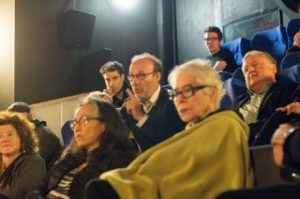 video introduction by legendary Québécois director Jacques Godbout, followed by a screening of his “film de gogo-vérité”, Kid Sentiment. A round-table discussion with original staff of the Youth Pavilion, Yves Laferrière and Monique Simard, was hosted by filmmakers Denis Chouinard and Caroline Martel. The day concluded with the UK première of Guylaine Maroist’s “documentary thriller”, Expo67: Mission Impossible, framed by a café-concert by Martin Aubin and Jessica Pruneau performing a bilingual set of hits from 1967.
Day two focused on Québécois and indigenous (national/nationalist) cultures through a mini film festival sponsored by the Cinémathèque québécoise, including 1960s films by Michel Brault, Michel Régnier, Willie Dunn, Gilles Groulx, Mike Mitchell, Jacques Godbout and Françoise Bujold. Governor-General’s award winner Jean-Philippe Warren (Concordia University) gave the first keynote lecture on the culture of 1967 and the day closed with a reception and a live performance of Gordon Lightfoot’s “Canadian Railroad Trilogy” by Ron Leary.
 Day three (3 Nov) took place at Senate House with a full day of plenary sessions on Expo67 and World Exhibitions, including papers by Craig Moyes (KCL), Jocelyn Létourneau (Laval), Bill Marshall (Stirling), Heesok Chang (Vassar), Joy Knoblauch (Michigan), Peter Scriver (Adelaide), John Gold (Oxford Brookes), Mike Darroch (Windsor), Johanne Sloan (Concordia), Denis Chouinard (UQÀM), Will Straw (McGill). The conference dinner was generously sponsored by the Délégation générale du Québec à Londres, and attended by the new Agent General, Mr John Anthony Coleman.
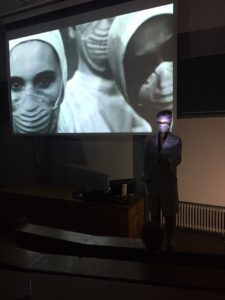 Day four (4 Nov) began at King’s College London with sessions dedicated first to indigenous culture at Expo67 (Ruth Phillips, Carleton; Linda Grussani, Canadian Museum of History), then to the audiovisual culture of Expo67 (Janine Marchessault, York; Monika Kin Gagnon, Concordia; Yuval Sagiv, York; Scott Birdwise, York; Guillaume Lafleur, Cinémathèque québécoise; Caroline Martel, Concordia), and finally to the avant-garde medical filmmaking pioneered by Robert Cordier for Expo’s Meditheatre (Kirsten Ostherr, Rice; Steven Palmer, Windsor). The academic programme culminated in a newly commissioned performance piece by Gilda Stillbäck to accompany Cordier’s film Miracles in Modern Medicine, attended by Mr Cordier himself.
The symposium concluded with a special programme of experimental Expo67 films at the BFI Southbank, including rare competition winners from 1967 provided by the Cinémathèque québécoise, remastered copies of audiovisual experiments provided by CinémaEXPO67, and new works by Ian Helliwell (Expo67—An Audiovisual Collage) and Phil Hoffman and Eva Kolcze (By the Time We Got to Expo).

Steven Palmer and Craig Moyes, BFI
Craig Moyes, Director of the CQFCS, IMLR
 We are grateful to the following sponsors for their generous support: Association internationale des études québécoises (AIEQ); Baizdon; British Film Institute; Canada-UK Foundation; Cassal Endowment Fund; Cinema Expo67; Cinémathèque québécoise; Institute of Modern Languages Research (School of Advanced Study, University of London); The Modern Languages Research Initiatives Fund (King’s College London); La Chaire René Malo (Université du Québec à Montréal); La Délégation générale du Québec à Londres; Louis Latour Agencies; Results Direct; Social Sciences and Humanities Research Council of Canada (SSHRC); The James McGill Chair in Urban Media Studies; University of Windsor.
Translating Development
Hilary Footitt discusses the seminar ‘Translating Development’ held at the IMLR in October 2017

1.
What happens when you bring translators working in development NGOs together with academics in Translation Studies, and MA Translation Degree course tutors? The Translating Development seminar on the 12th October 2017 at the IMLR was an opportunity to find out.
The discussion started off with translators in NGOs talking openly about their work – Alberto Sanz Martins from OxfamGB, Verity Leonard Hill from Save the Children, Jessica Matthews, Alliance Development Coordinator in Family for Every Child, and Patricia Sommer, a freelance translator with several large NGOs. Presenters spoke about the challenges of managing Translation Services in large and complex NGOs whose work could span over 90 countries, and the language problematics of sharing knowledge and practice across global partnerships. A major challenge is the overall development context in which language and communication are seldom included as standard parts of the influential monitoring and evaluation procedures which large institutional/government donors typically require. Translators talked about having to actively advocate for translation within their organisations, working alongside colleagues to raise awareness of the key role of languages in achieving development objectives.
The academic panellists (Alexa Alfer from the University of Westminster, Christina Schaeffner from Aston University, Jane Woodin from Sheffield, Jonathan Evans from Portsmouth, Myriam Salama-Carr and Rebecca Tipton from Manchester, and Sarah Griffin-Mason, Chair of ITI) talked about the complexity of the ‘language mediated listening’ in which development NGOs are engaged, and asked questions about the balance of translated material from and into English. To what extent, they wondered, does existing literature on translation and globalisation help explore the issue of development translation? Does the very context of globalisation blur any possible boundaries between translating development and translating other types of dynamics and power relations? The translators as agents – affected by the sometimes traumatic material they might be asked to translate, or finding themselves acting as advocates for translation within the NGO – echoed much recent academic work on the positionality of the language intermediary.
Throughout the different stages of the development cycle, NGO colleagues pointed out, NGO staff who are not trained translators are inevitably involved in language mediation. Seminar participants discussed what this fact implied for traditional constructions of language professionalisms. Was there a way in which the development world could begin to envisage the capacity building of translators and language services as integral parts of their sustainability initiatives?
Strongly emerging from the seminar was the sense of translators in development NGOs as being a creative community of practice which felt itself to have common needs and had already in some cases established informal networks of mutual support. Arguing for greater visibility for translation within the NGOs themselves – do translators have their own profiles on NGO websites? – and recognising language mediation as an integral part of development discourse and operations were seen as vital for the future.
Participants suggested building on the seminar and the connections it had created by establishing a more formal network of support for translators in development NGOs. Comments at the end on ‘Next Steps’ – ‘good to have the mix of translators, academics and NGOs’; ‘possibility of collaborating with universities’; ‘concrete actions to work jointly on research for priority topics’ – suggested that this dialogue between NGO translation practitioners and academics is a valuable one to continue.
Find out more information on the AHRC project The Listening Zones of NGOs: languages and cultural knowledge in development programmes
Hilary Footitt, Research Professor, University of Reading, and PI for the AHRC project ‘The Listening Zones of NGOs’
- 19.10.2010. Nad e Ali District Centre, wheat seed from the wheat seed distribution program is handed out to local farmers. ACT Imagery taken in Nad e Ali, Helmand Province, Afghanistan. Photo: SAC Neil Chapman (RAF)/MOD, Department for International Development (DFID), Creative Commons Attribution Licence CC by 2.0. https://www.flickr.com/photos/dfid/5732728333/
Romance Language Collections in Senate House Library and the School of Advanced Study
Matthew Coneys discusses his work scoping Romance language collections held across Senate House Library and SAS Institute libraries, with a view to making them more accessible to researchers of Modern Languages

1.
Since April I have been working to scope the Romance language holdings in Senate House Library and the libraries of the School of Advanced Study research institutes. The project seeks to uncover some of the hidden treasures within the collections, as well as their broader areas of strength, and to promote these resources to Modern Languages researchers. This rewarding task has involved working with a wide range of material across languages: from medieval Italian prayer books and early manuscripts of Voltaire’s short stories to illustrated editions of Catalan nationalist poetry and pamphlets of Che Guevara’s political speeches.
The biggest initial challenge was knowing where to begin. An enormous amount of Romance language material is held across the libraries: Senate House Library, for example, displays 69,000 items in French alone on its open shelves. I have benefitted from the advice of librarians across the institutes who have pointed me in promising directions, provided useful data and allowed me to access areas normally off limits to the public. Some of the most interesting material I have found was stumbled upon by accident, such as a collection of early Baedeker guides to southern Europe and a seventeenth-century Italian manuscript containing the reflections of a papal diplomat on a possible marriage between the future Charles I of England and the Spanish Infanta.

2.
Much of my work has focused on special collections, with the aim of highlighting the value of unique material to specific groups of researchers. This objective informed the organisation of a recent workshop on the Eliot-Phelips Collection, an exceptional body of printed primary sources on early modern Spain. I have also spoken about various areas of my work at conferences and study days, and will be introducing the Romance collections as part of the IMLR and Senate House Library research training programmes. The most tangible result of the project will be an interactive guide to the collections on the IMLR website, offering an overview of the libraries’ holdings and facilitating access to finding tools and other guides.

3.
It has been especially interesting to explore how the different libraries complement each other, offering a range of perspectives on, and resources for, certain fields of study. One such area is eighteenth-century France, with Senate House Library’s outstanding holdings of legal documents and revolutionary pamphlets supplemented by rich sources for the study of French local and regional history in the library of the Institute of Historical Research (IHR). Another area of cross-institutional strength is the history of travel writing: the IHR and Warburg Institute libraries contain comprehensive holdings of edited early modern travel accounts, which together with manuscripts and early printed books in Senate House Library and collections of more recent publications in the Institute of Latin American Studies and Institute of Commonwealth Studies offer a unique resource for research in this area.
Working with the collections has been a privilege. I have spent numerous mornings consulting manuscripts and printed books in the Special Collections Reading Room, and afternoons wandering the closed stacks in Senate House tower. On the odd occasion when I bump into a librarian, I am often told how lucky I am to be able to wander around looking for interesting books. Hopefully, this project will encourage others too to spend time browsing the unique range of Romance language material to be found in the University of London.
Matthew Coneys, Postdoctoral Research Fellow (Romance Languages)
- MS361 Proposed marriage of Charles, Prince of Wales, and the Infanta Maria (c. 1623) fols. 15r. With permission of Guildhall Library, City of London (held in Senate House Library)
- Pedro de Medina ‘Libro de grandezas y cosas memorables de España’ (1549) [E.P.] MQA [Medina] fol. SSR. With permission of Guildhall Library, City of London (held in Senate House Library)
- Octave Uzanne ‘L’Ombrelle, le gant, le manchon’ (Paris, 1883) [Uzanne 007]. With permission of Senate House Library
Blazing a Trail into Modern Languages Research
Join Katia Pizzi as she introduces the IMLR’s Research Training programme: a series of seminars and workshops run throughout the year for all to access free of charge
 The IMLR is a hub of research training in Modern Languages, stimulating initiatives and collaborating with language departments nationally.
Collaborations and activities gathered initially around a series of monthly day-long workshops devised in the early 1990s by the then-named Institute of Romance Studies. Revised on an annual basis, tailored to individuals and small groups, this seminar series has grown organically and exponentially into a fully-fledged programme, sustained by active participation of graduate students from all over the UK and Europe. We thrive on the input of sister Institutes within the School of Advanced Study (SAS), languages departments and translation agencies, libraries, museums, heritage trusts, NGOs, publishers, etc. The British Library, the Wiener Museum and Library of the Holocaust, the Tavistock Square Memorial Trust, and Refugee and Migrant Justice are established friends and partners.
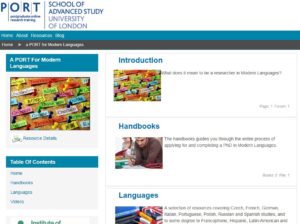 A-Port-for-Modern-Languages is one of the jewels in our crown. The Institute began work to build PORT in the late 1980s, thanks to a grant obtained from the Arts and Humanities Research Board. A-Port-for-Modern-Languages comprises resources in French, Spanish, Portuguese, German, Italian, Polish, Czech and Russian studies. In addition to specific resources, PORT will help gain an understanding of issues involved in applying and progressing in doctoral studies in Modern Languages, organising a conference, preparing and giving a research presentation and writing a successful CV. PORT was arguably the first and, to this day, the only substantial digital platform exclusively tailored for Modern Languages Research, accessible openly from the Institute’s Research Training webpages and free of charge. Open Access before the letter! And it’s as yet unrivalled too!
Further initiatives have stemmed from the leadership of IMLR Research Training. In 2006 the Institute received an AHRC grant to lead and build a research training network across the School of Languages at the Universities of Birmingham, Leeds and Glasgow, leading to graduate conferences and workshops. This was followed in 2012 by a network of King’s College and University of London in Paris, also led by the Institute and driven by funding obtained from the AHRC’s Skills Development scheme. This culminated in an international Modern Languages and Film Spring School in 2013, with visits to archives in Rome, Gorizia, Berlin, Madrid, Paris, as well as London.

Jeremy Mortimer – ‘Migrating Texts’
More recent partnerships and initiatives include the student-led annual workshop Migrating Texts, funded by LAHP and the European Commission, to explore the world of interlingual translation, from dubbing to subtitling to adapting texts, involving BBC radio professionals, EU translators and film producers. We also welcome the recent collaboration with the AHRC funded Researching Multilingually grouping of the Universities of Durham, Manchester, St. Andrews and Glasgow.
What is the meaning of doing research multilingually? How do researchers draw on their own linguistic resources, and those of others, when undertaking research involving more than one language? These are the fundamental questions asked in research in the Modern Languages. These are precisely some of the questions that IMLR’s Research Training mission aims to address.
Katia Pizzi, Senior Lecturer in Italian Studies/Director of the Centre for Cultural Memory, IMLR